
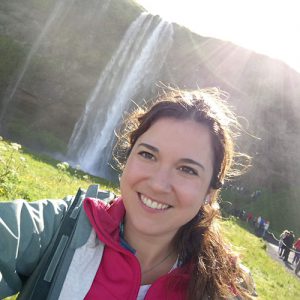
How would you describe yourself in 3 words?
Creative, reliable, communicative.
Brief background/short CV
I’m an Italian neuroscientist working at the MRC Laboratory of Molecular Biology (LMB). Previously, I studied Biomedical Sciences in Padua where I worked with Prof Elisa Greggio who inspired me to pursue a career in Neuroscience. I spent one year in Paris during my Masters working on a new therapy for neuropathic pain. I then joined a shared PhD program at the NIH (USA) and UCL (UK) and completed my degree in Neurogenetics in 2017. During the PhD I studied genetics of Parkinson’s disease and related mechanisms of protein aggregation. I’m now working on cerebral organoids in Dr Madeline Lancaster’s lab where she recently developed a model to study the choroid plexus and cerebrospinal fluid secretion in vitro.
What do you do?
Currently I am working on an in vitro model of one of the barriers of the brain: the choroid plexus. Development of human choroid plexus in a dish could help to perform preclinical tests to assess the permeability of different drugs to the brain.
Brief description of a typical day
The protocol to make organoids has multiple stages spread around several weeks. I routinely make organoids and take care of the cells we use to generate them. I prepare samples to analyse and to look at with the microscope. I also spend a lot of time at the computer, working on presentations or analysing data using different programs. I regularly discuss my project with my co-workers and supervisor.
What’s the best thing about your job?
I love the variety and flexibility of this job, the collaborative and creative aspects of research. I like the fact that science is international. I feel very lucky to be able to travel to conferences to communicate my findings and to work with so many interesting and passionate people.
If you weren’t doing this job, what would you be doing instead?
I would probably like to work in science communication, journalism or in a company that advances communication between industry and academia.
Your top tip for someone thinking about a career in science?
Science is hard work so I think it’s important to follow an interesting question while maintaining the focus on the bigger picture. Time management and ability to negotiate are also key skills.
What or who inspired you to follow your career?
I was always fascinated with biology and biomedical sciences at school. I initially wanted to be a marine biologist and later on decided to study biomedical sciences. I particularly enjoyed the neuroscience and physiology lectures. During my third year of university I met Prof Elisa Greggio, an excellent and enthusiastic young scientist in Padua, who inspired me to continue my career in neuroscience.
What did you want to be after you left school?
Medical doctor or geneticist.