
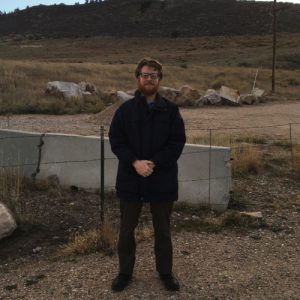
How would you describe yourself in 3 words?
I don’t know
Brief background/short CV
I was born in Denver, Colorado, and often visited the Rocky Mountains. My favourite part of camping in the mountains was looking at the stars on a clear night. This translated into an interest in astronomy, which transitioned into astrochemistry. The transition was largely due to astrochemistry involving the study of nebulae, and I’ve always found nebulae to be the most beautiful features of the heavens.
BS at University of Colorado Denver Health Sciences Center, PhD at The Ohio State University working on astrochemistry with Eric Herbst, PostDoc at University of St Andrews working on planetary atmospheric chemistry with Christiane Helling, and now a Simons Senior Fellow working on origins of life at the MRC Laboratory of Molecular Biology.
What do you do?
I work on simulating conditions in the lab that more accurately represent local environments on early Earth, before life arose. My colleagues perform experiments within these simulated environments, and the success or failure of these experiments helps to inform the prebiotic chemistry itself, as well as the plausibility for particular geochemical scenarios to harbour this chemistry.
Brief description of a typical day
I have three typical days. Some days I talk with astronomers and physicists about observations of other stars and planets, and what these reveal about surfaces of rocky planets. Other days, I work with geologists to model the environments on the early Earth: volcanos, impact events, atmospheric photochemistry, and simulate some of these environments in the lab to see what chemicals of prebiotic significance they may provide. Finally, some days, I work in the lab to set up these scenarios, with the right kind of light and chemistry, for the organic chemists to use, and at the same time I learn from the organic chemists about new reactions they’ve found, and will go back and tell the geologists and astronomers about them, so we can investigate where on Early Earth these reactions would most likely have taken place.
What’s the best thing about your job?
I enjoy being confused. When I’m confused, that means there’s a mystery, something I don’t understand and have to work very hard to try to figure out. I like this feeling of confusion, and I get to enjoy this feeling a large fraction of every day.
If you weren’t doing this job, what would you be doing instead?
If I was better at writing poetry, I would do that. Otherwise, maybe I would have been a farmer.
What or who inspired you to follow your career?
My father, my faith, Baruch Spinoza, Carl Sagan, the Rocky Mountains
What did you want to be after you left school?
A string theorist.